
A new car seat, still in its packaging, certified according to the latest standard, installed in a recent vehicle: one might think safety is guaranteed. In practice, data from the National Safety Council and AAA published in September 2026 shows that incorrect use remains the main risk factor, even with compliant equipment.
Choosing a safe car seat is not just about ticking a box on the label. It starts with a concrete check of the installation, compatibility with the vehicle, and adjustment to the child’s actual size.
Car seat installation errors: the risk that the standard does not cover
The seat is installed, the Isofix click is heard, and one thinks it’s all set. The reality on the ground is more nuanced: the trend of misuse has increased compared to 2024, according to the analysis of the National Digital Car Seat Check Form reported by AAA in September 2026.
The most common errors are not spectacular. A harness that is too loose (you can pinch a fold of strap between two fingers), a shell tilted at the wrong angle, a belted seat with more than one centimeter of lateral play at the anchorage point. Each of these defects reduces protection in the event of a frontal or lateral impact.
To spot these issues before they matter, you can consult the practical advice from Maman Anonyme which details the checkpoints model by model. The idea is to check the installation with an outside perspective, not just to follow the manual.
A often overlooked point: compatibility between the seat and the vehicle’s bench. Some Isofix seats do not clip securely onto all seating configurations. Compatibility lists provided by manufacturers exist for this reason, but few parents consult them before purchasing.
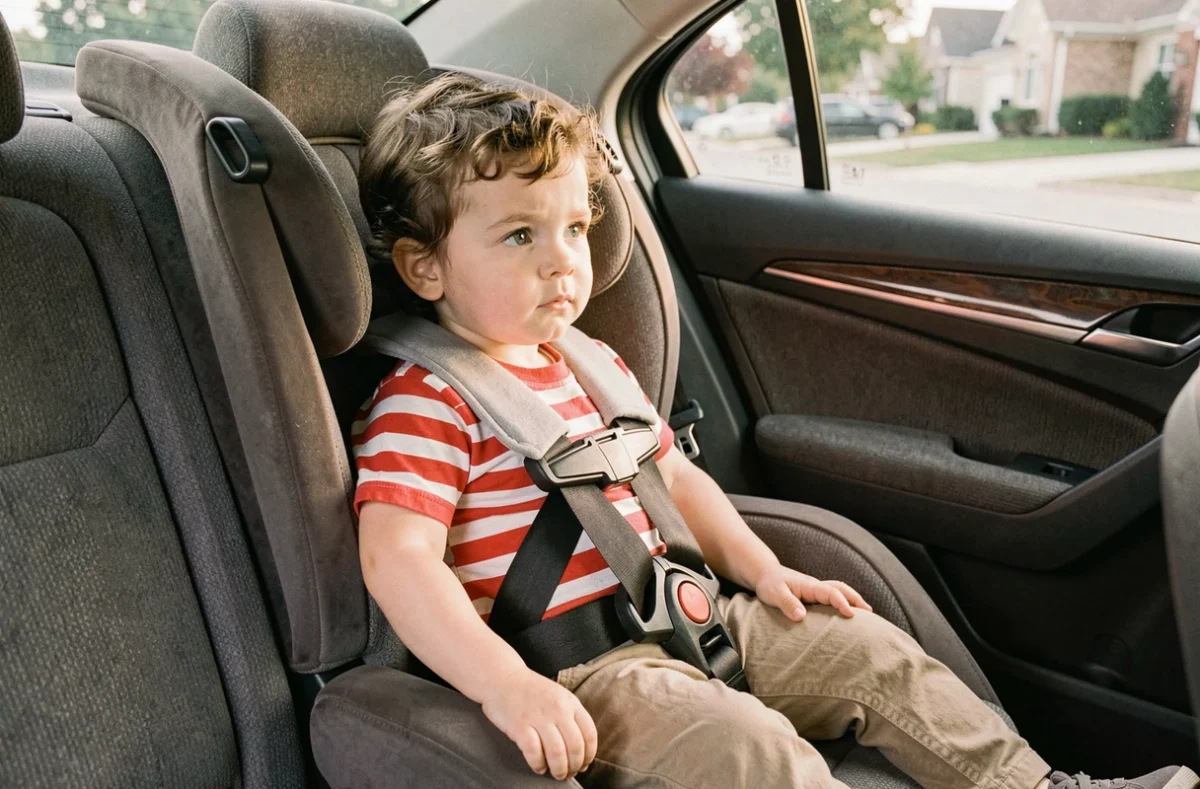
R129 standard and ADAC crash tests: two distinct evaluations of the car seat
Confusion is common: a seat certified R129 (i-Size) does not necessarily receive a good rating in ADAC tests, and vice versa. R129 is a regulatory requirement, ADAC is an independent evaluation. The two do not measure exactly the same parameters.
The R129 standard imposes minimum requirements: crash resistance, size classification, mandatory Isofix compatibility for certain categories. This is the legal baseline for marketing a seat in Europe.
ADAC tests go further. They evaluate safety, ease of handling, ergonomics, and even the presence of certain chemical substances in the fabrics. A seat can perfectly pass R129 certification and receive a poor rating from ADAC for handling or ergonomics.
What this changes at the time of purchase
It is beneficial to cross-reference both sources. An R129 seat guarantees legal compliance. A good ADAC result provides an indication of the seat’s actual behavior in crash conditions and its ease of use in daily life. The absence of a model in ADAC tests does not mean it is dangerous, simply that it has not been tested by this organization.
- Check that the seat bears the R129 (or ECE R129) marking on the certification label, not just on the commercial packaging.
- Consult the ADAC results for the exact model (including the year of manufacture, as versions evolve).
- Do not rely solely on price: ADAC tests regularly show that a high price does not guarantee a good safety result.
Rear-facing car seat: until what age to maintain this position
The R129 standard requires rear-facing until at least 15 months. In practice, many parents turn the seat to face forward as soon as the regulation allows, sometimes even before.
The rear-facing position protects the head, neck, and spine of the young child in the event of a frontal impact, which remains the most common type of accident. The neck muscles of a 15-month-old child are not comparable to those of an adult: keeping rear-facing as long as possible remains the most widely agreed recommendation among road safety organizations.
Feedback on this point varies among families: some children do not tolerate prolonged rear-facing well, while others adapt without difficulty. The key is not to change position for convenience but to wait until the child reaches the size limits of the seat in rear-facing configuration.
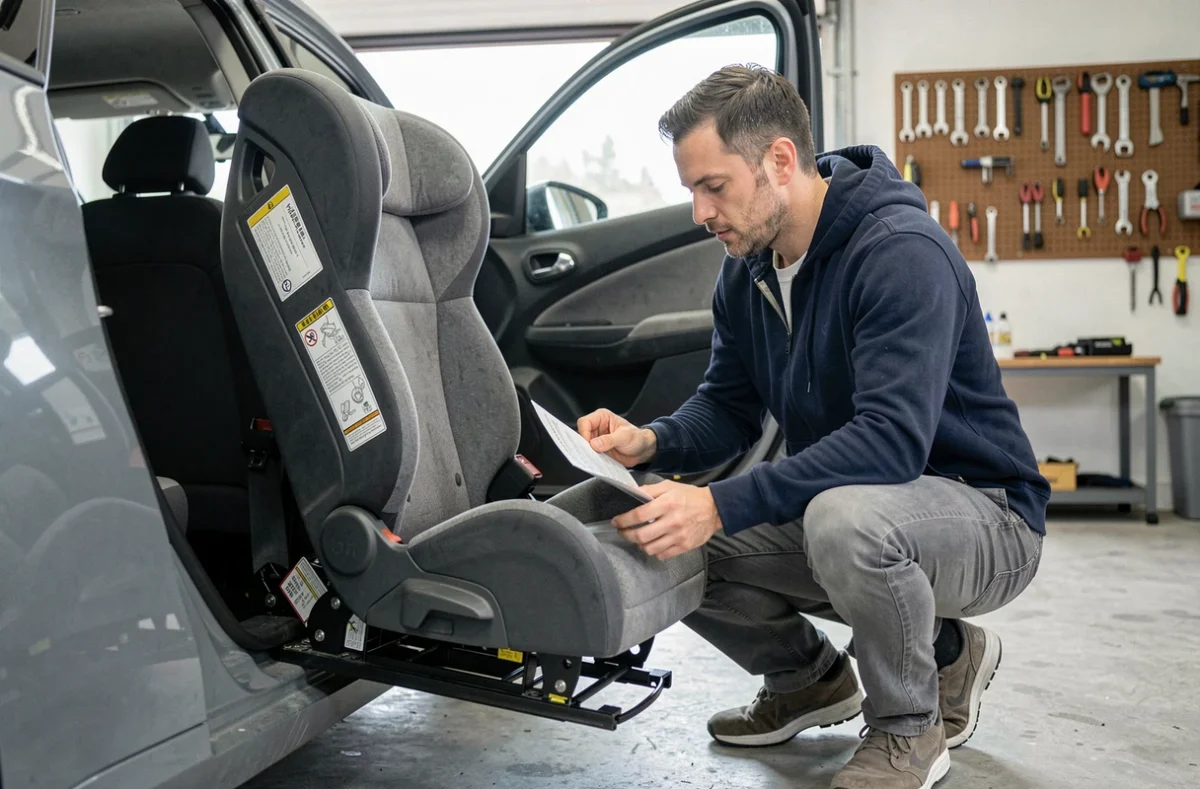
Used R44 car seat: what the end of marketing implies
Since September 1, 2024, new R44 certified seats can no longer be marketed in Europe. This ban concerns the sale of new seats, not the use of an already purchased R44 seat.
In practice, a well-maintained R44 seat, that has not been in an accident, and whose manufacturing date does not exceed the lifespan indicated by the manufacturer, remains legal in the car. The distinction is especially important for second-hand purchases: a second-hand R44 seat is usable, but will no longer be replaced by an equivalent model in stores.
Points of caution regarding used seats
- Check the manufacturing date on the label (usually under the seat or at the back of the shell). Manufacturers indicate a lifespan, often around several years.
- Refuse any seat whose accident history is unknown. An impact, even moderate, can compromise the internal structure without visible signs.
- Ensure that the harness, buckles, and Isofix anchorage points function without play or abnormal resistance.
The gradual transition to R129 simplifies the reading of categories (size rather than weight), but it does not render R44 seats already in circulation obsolete overnight. The decisive criterion remains the actual condition of the seat, not the standard listed on the label.
Another point to keep in mind: according to AAA, many children transition to adult seat belts too early. The choice of car seat does not stop in early childhood. A booster seat with a back remains relevant as long as the three-point belt does not fit properly over the child’s shoulder and pelvis, regardless of the age indicated on the packaging.