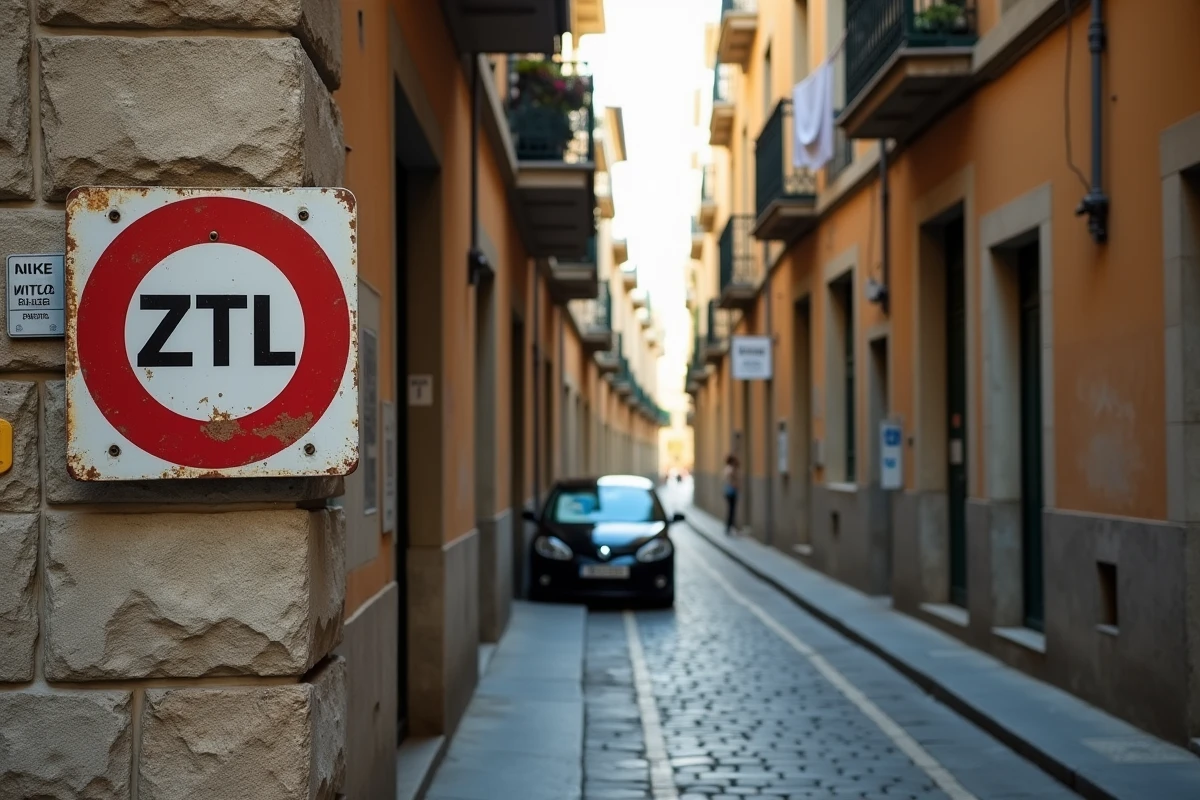
The ZTL of Palermo (Limited Traffic Zone) traps thousands of drivers each year, both locals and tourists. Surveillance cameras operate without visible warning, signs are often discreet, and the pass system relies on rules that most travel guides summarize poorly. Before driving in the historic center, it is better to understand how this zone actually works and the mistakes that can be costly.
Activation of the ZTL pass in Palermo: the trap that the ticket alone does not solve
Buying a ZTL pass is not enough. This is the point that most travelers discover too late, sometimes receiving a fine several weeks after their stay. In Palermo, the pass must be activated for each day of use, either via the app or by providing the license plate number at the time of purchase.
A pass that is paid for but not activated for the relevant day leaves the vehicle in violation. Cameras read the plates at every entry point of the ZTL, and the system checks the activation in real-time. The fine for unauthorized entry ranges from several dozen euros per recorded passage.
For those planning to drive in the ZTL of Palermo with a rental vehicle, the activation procedure may vary depending on the rental company. Some agencies offer to manage the pass, while others leave it to the customer. Checking this point at the counter avoids surprises upon return.
ZTL Centrale and ZTL Notturna: two zones, two schedules, two logics
Palermo does not operate with a single uniform ZTL. The city distinguishes between the ZTL Centrale, active during the day in the perimeter of the historic center, and the ZTL Notturna, which covers certain areas in the evening and at night, particularly around pedestrian axes like via Maqueda.
The activation times change according to the time of year and the days of the week. This variability makes any rigid planning risky. A permitted trip on a Tuesday morning can trigger a fine on Friday evening on the same route.
Signage and on-the-ground identification
Signs indicating the entrance to the ZTL exist, but their visibility leaves much to be desired in several narrow streets of the center. They are often partially obscured by vegetation or placed high up. Feedback from travelers on specialized forums converges on this point: spotting the signs while driving in Palermo traffic is a challenge, especially for a driver discovering the city.
Public GPS applications (Google Maps, Waze) sometimes indicate ZTLs, but their reliability on exact timings remains uneven. Relying solely on GPS to avoid a restricted area offers no guarantee.
License plate declaration by central hotels: a regulated tolerance
Many accommodations located within the ZTL can declare their clients’ vehicle license plates to the municipality (via AMAT, the mobility agency of Palermo). This declaration neutralizes fines related to entry and exit during check-in and check-out.
The main condition: the plate must be communicated within a specific timeframe after entry, usually within 24 hours. Exceeding this timeframe cancels the tolerance. Therefore, it is necessary to provide the registration number as soon as the reservation is made or immediately upon arrival.
- Contact the hotel before departure to confirm that they practice license plate declaration and know the exact procedure.
- Provide the complete registration number, including the country of origin, as the cameras record the plate as is.
- Request written confirmation (email or message) of the declaration made to AMAT, in case of subsequent disputes.
Not all central hotels offer this service. Private rentals (like Airbnb) do not always have access to it. Checking this point before booking accommodation within the ZTL perimeter can prevent accumulating fines over several days.
ZTL fines in Sicily: receipt delays and contesting from France
ZTL fines in Palermo are not placed on the windshield. They arrive by mail, sometimes several months after the infraction, in the name of the rental contract holder or the vehicle owner. For a rented vehicle, the rental company usually forwards the fine to the driver identified on the contract, adding management fees.
The amount per unauthorized passage ranges between several dozen and over a hundred euros, depending on the category of infraction. Multiple passages (round trips, for example) generate as many distinct fines. Three round trips over two days can produce six fines.
Possibilities for contesting
Contesting from France is theoretically possible, but field feedback varies on this point. The procedure goes through the Comune di Palermo, in Italian. Processing times are long, and acceptable reasons are limited to material errors (incorrect plate reading, for example) or proof of a valid pass activation.
Keeping all receipts (pass purchase confirmation, proof of activation, email from the hotel confirming the plate declaration) is the only real protection in case of dispute.
Concrete alternatives to driving in the center of Palermo
Parking the vehicle outside the ZTL and visiting the center on foot remains the most reliable strategy to avoid any fines. Several monitored parking lots are located on the immediate outskirts of the historic center, just a few minutes’ walk from the main sites.
- The parking lots near the central station (Stazione Centrale) offer quick access to the center without passing through any ZTL cameras.
- Parking along the Foro Italico, when available, allows access to Kalsa and the waterfront without entering the regulated zone.
- Urban buses and trams serve the main axes of the center, with decent frequencies during the day.
For stays of several days, leaving the car in the hotel parking lot outside the ZTL and using public transport reduces stress and financial risks. The historic center of Palermo is easily explored on foot: the distances between markets, baroque churches, and via Maqueda rarely exceed one kilometer.
The ZTL of Palermo operates according to precise but poorly disseminated rules outside of Italy. The combination of activated pass, hotel declaration, and retention of receipts covers most situations. For those who prefer to avoid the subject, parking outside the zone and walking remains the simplest option, and probably the most enjoyable way to discover the city.